


How to choose a shoe cabinet for a narrow hallway
For a narrow hallway, check more than cabinet depth: measure the walkway, open compartments and the largest shoes you need to store.
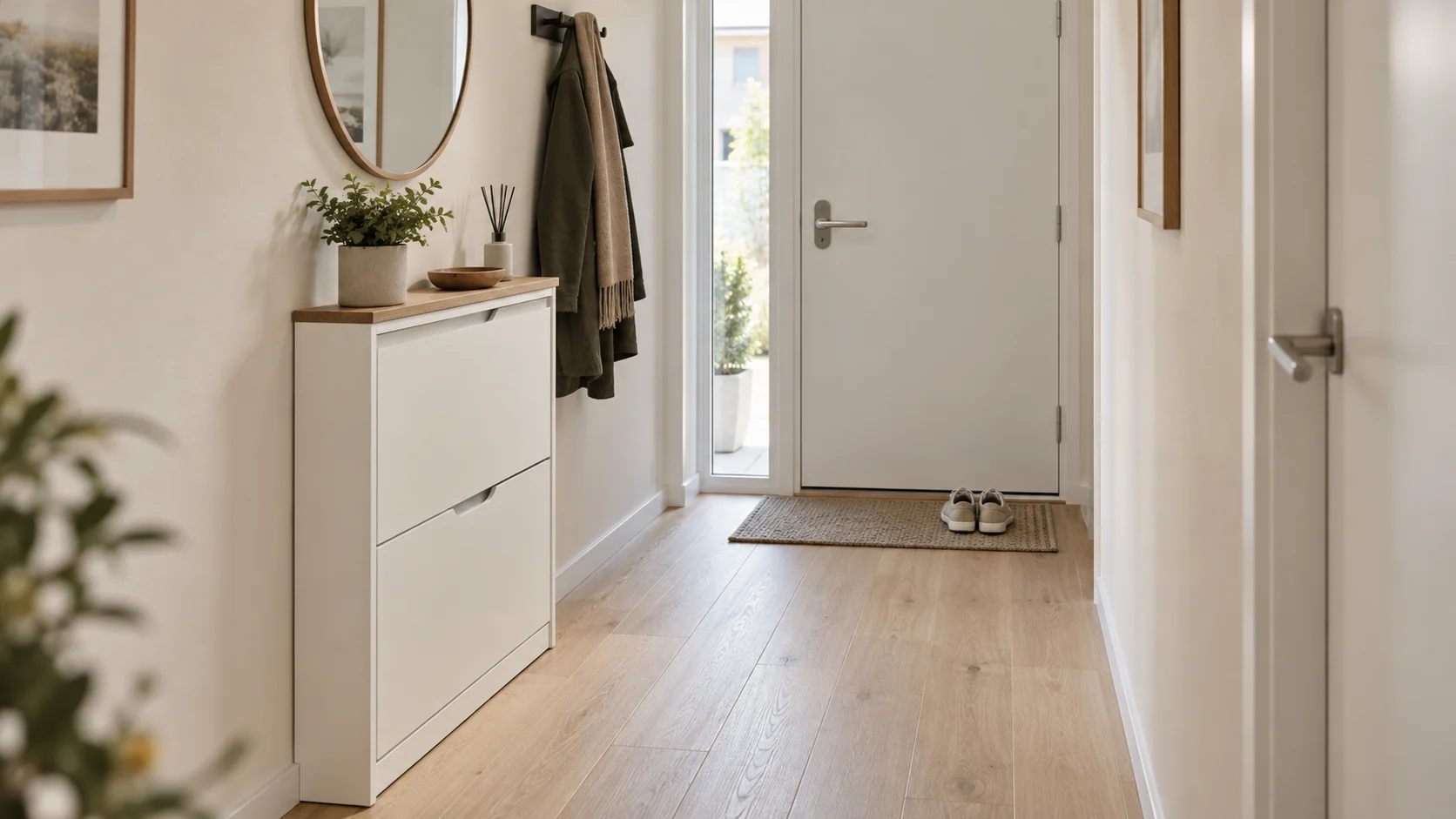
A shoe cabinet suits a narrow hallway when it fits closed, opens without blocking doors and holds your actual footwear. Start with cabinet depth, walking space and your longest shoe; consider pair counts and colour afterwards. Browse the shoe cabinets and racks category for different designs. This guide compares 15 cm and 24 cm deep cabinets, an adjustable-shelf cabinet and a shoe bench.
What shoe cabinet depth works in a narrow hallway?
“Narrow” can mean a small width or a shallow depth. In a long corridor, depth out from the wall usually matters most; in a short alcove, width along the wall can be the limit. Listings use different dimension orders. Identify width, depth and height separately rather than guessing from three numbers.
Measure the tightest point, skirting boards, handles, radiators and other projections. Include any gap that the design needs behind it. For example, a 100 cm wide hallway with a 24 cm deep cabinet and a 2 cm wall gap leaves 74 cm: 100 − 24 − 2 = 74. This illustrates the calculation; it is neither a mandatory clearance standard nor a comfortable width for every household.
Mark the cabinet footprint with removable tape and walk past carrying your usual bag, wearing a coat or pushing the equipment you use at home. Check the entrance door and neighbouring room doors separately. Then allow for the open tilt-out compartment or hinged doors: closed depth does not describe the full operating space.
Tilt-out fronts need additional space in front; hinged doors can interfere with furniture beside them. If the listing does not give the open dimensions, ask before ordering. Our console table buying guide helps if the same hallway also needs a surface for keys and everyday essentials.
Tilt-out compartments, shelves or a shoe bench?
A tilt-out shoe cabinet can have a shallow body because footwear sits at an angle. Large trainers, wide boots or high heels may still be too bulky. Check compartment height, width, maximum shoe length and divider adjustment. Removing a divider may create space for one larger pair while reducing total capacity.
Adjustable shelves behind hinged doors give you more options for arranging the height. For tall boots, check whether shelves are removable: adjustable does not necessarily mean removable. A deeper cabinet may fit bulkier footwear, but takes more walkway space and still needs room for the doors.
A shoe storage bench combines footwear storage with somewhere to sit while putting shoes on. Try the seated position and allow room for your knees and bending forward. Only sit on a model designed for seating. A conventional cabinet’s top load rating does not establish that it can support a seated person; check the bench’s seat rating and instructions.
A tall cabinet uses wall height, but the top compartment must remain reachable. Wall-mounted designs need a suitable wall and installation; a floor-standing unit may also require anti-tip fastening. For a broader view of space planning, see our small room layout guide.
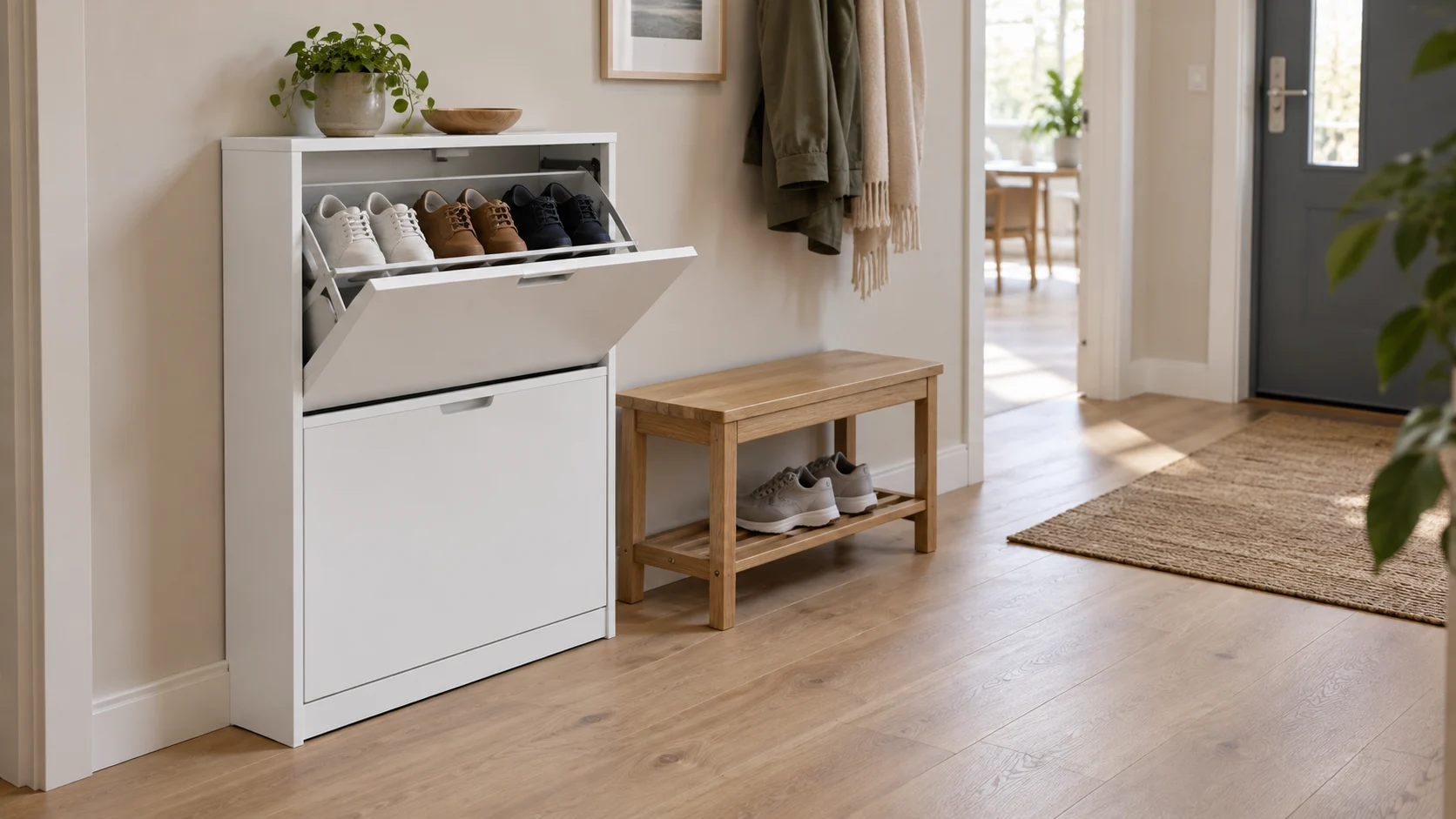
How many pairs fit, and how should you store them?
“Up to 18 pairs” does not mean 18 pairs of any size. Separate daily footwear from seasonal storage. Measure your longest outer sole, the combined width of a pair and boot shaft height; measure boxes if you keep shoes boxed. Give each person a clear section and store occasional footwear elsewhere if necessary.
For a model with a 28 cm shoe-length limit, knowing only an EU size is not enough: external lengths differ between shoe designs. Compare your actual footwear with the stated usable space. If internal dimensions are missing, ask for them rather than estimating from cabinet depth.
Clean muddy footwear and dry wet shoes in a way suitable for their material before storing them. Ventilation openings help air circulate, but a cabinet is not a shoe dryer. Keep standing water away from board edges and follow the finish’s cleaning guidance. Open shelves offer quick access but provide less protection from dust.
Check the skirting board, feet, assembly requirements, fixing points and load limits. Fit anti-tip restraints according to the product instructions, using fixings appropriate for your wall. Supplied screws may not suit every wall type; ask an installer if the underlying wall material is unclear.
Four shoe storage models: depth and daily use
This comparison uses Bonideco product descriptions, not hands-on testing. All dimensions below use the same order: width × depth × height. Check current prices, delivery and availability in the product cards.
| Model | Width × depth × height | Documented features | What to check |
|---|---|---|---|
| 837-566V01WT | 55 × 15 × 105.5 cm | Metal body, three tilt-out compartments; up to six pairs and maximum shoe length 28 cm. | Very shallow body but limited shoe length; opening space and wall fastening. |
| SONGMICS HOME LBC228WE01 | 60 × 24 × 102.8 cm | Two tilt-out compartments, adjustable internal divider and open shelf. | Usable compartment size and clearance to tilt the fronts open. |
| 837-626V91WT | 70 × 35 × 108 cm | Two hinged doors and six adjustable shelves; listing states up to 21 pairs and EU 45. | 35 cm depth, open doors and shelf arrangement for tall boots. |
| VASAGLE LSB121WB01 | 60 × 30 × 53.5 cm | Cushioned bench, three storage levels and an adjustable tilt-out compartment; up to six pairs. | Seating, knee and opening space; seat load limit in the instructions. |
Seven checks before ordering
- Identify width, depth and height separately.
- Include skirting boards and any required wall gap.
- Try the walkway and all neighbouring doors.
- Check the furniture’s space with compartments open.
- Measure your largest pair against usable internal dimensions.
- Confirm materials, load limits, assembly and fastening.
- For a bench, check seating suitability; confirm delivery and what is included on the product page.
Common questions about shoe cabinets
Will a 15 cm deep shoe cabinet fit every shoe?
No. Shallow body depth does not reveal the usable compartment size. The 15 cm model in this comparison states a maximum shoe length of 28 cm.
What is the difference between narrow and shallow?
Narrow may describe width; shallow means the cabinet projects less into the walkway. Check both dimensions rather than relying on the product name.
How can I store tall boots?
Look for sufficient internal height and removable shelves or dividers. Measure the boot shaft; tilt-out compartments can be restrictive for tall boots.
Can I sit on a shoe cabinet?
Only when the product is designed for seating and its seat load limit is documented. A regular cabinet top is not a bench.
Can I put wet shoes in a ventilated cabinet?
Ventilation does not replace drying. Dry your footwear before storing it and avoid leaving water on the furniture.
Does a floor-standing cabinet need wall fixing?
Follow the specific product instructions. Floor-standing furniture may require an anti-tip restraint, with fixings suitable for the wall material.
With your measurements ready, compare shoe cabinets and racks. For planning the whole entrance area, our apartment interior guide explains zones and furniture placement.