


Spice jars and mills: choosing the right size and 4 options
A practical guide to jar capacity, lids, drawer space and grinding mechanisms, with a comparison of four different options.
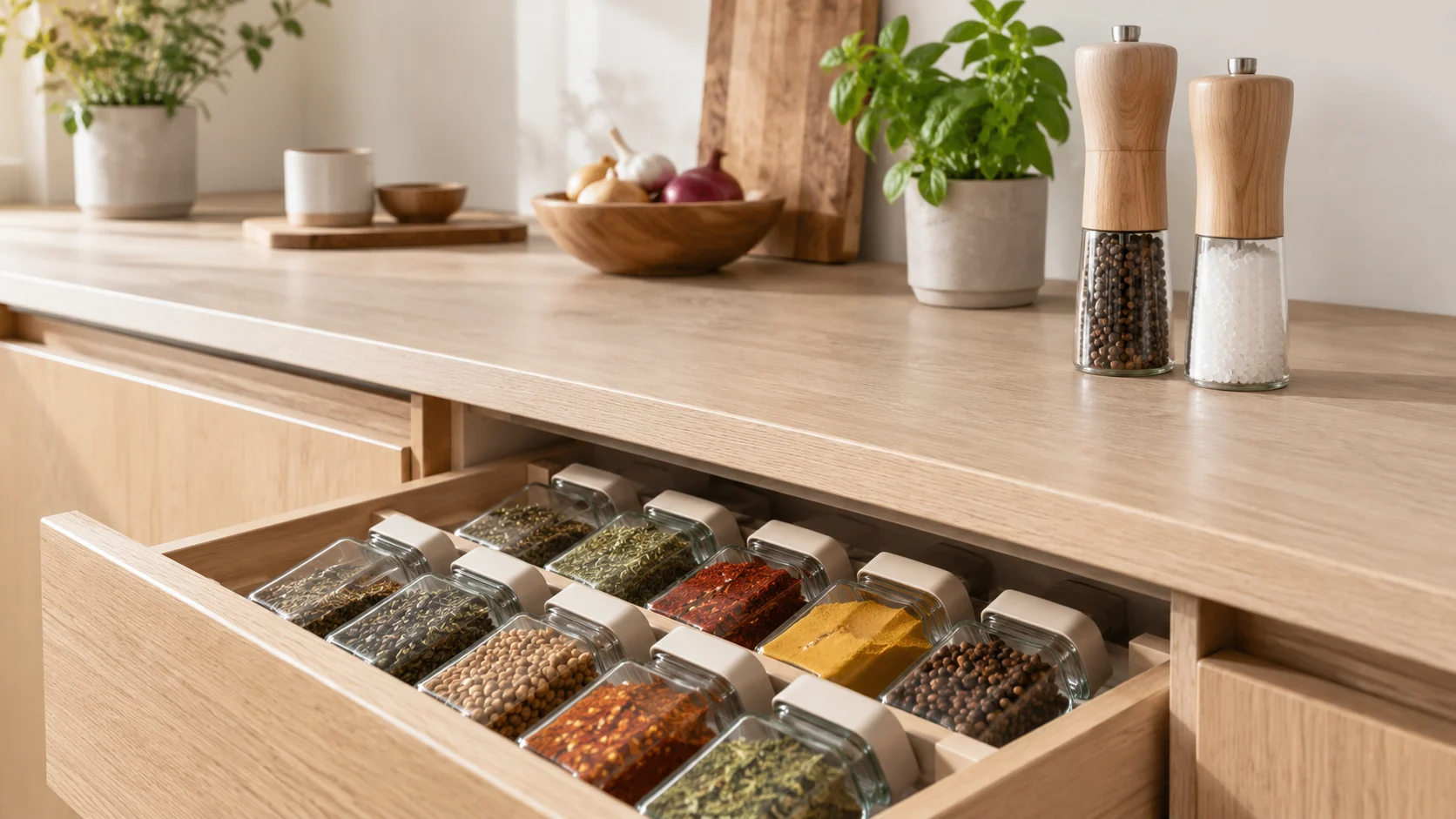
Good spice jars make paprika, cumin and oregano easy to find, but a matching set is only useful if it fits your kitchen and everyday habits. The jars need convenient openings and well-fitting lids; a grinder needs a mechanism suitable for the ingredients you actually use. This guide compares four different options from the Bonideco spice jars and mills range, then shows how to measure the space, label the contents and choose between storage and grinding tools.
Quick choice: matching glass jars with labels suit an organised drawer; a rotating spice rack keeps frequent ingredients together; a salt and pepper mill set is useful at the table; a dedicated chilli cutter produces dried chilli flakes and serves a different purpose from a pepper grinder.
Spice jars and grinders: four options compared
These products solve different problems: two organise stored spices, and two process ingredients before serving. Availability and declared specifications were checked on 5 October 2026. The comparison is based on product information. Current prices, delivery details and availability appear in the product cards.
| Model | Size and contents | Use | Check before buying |
|---|---|---|---|
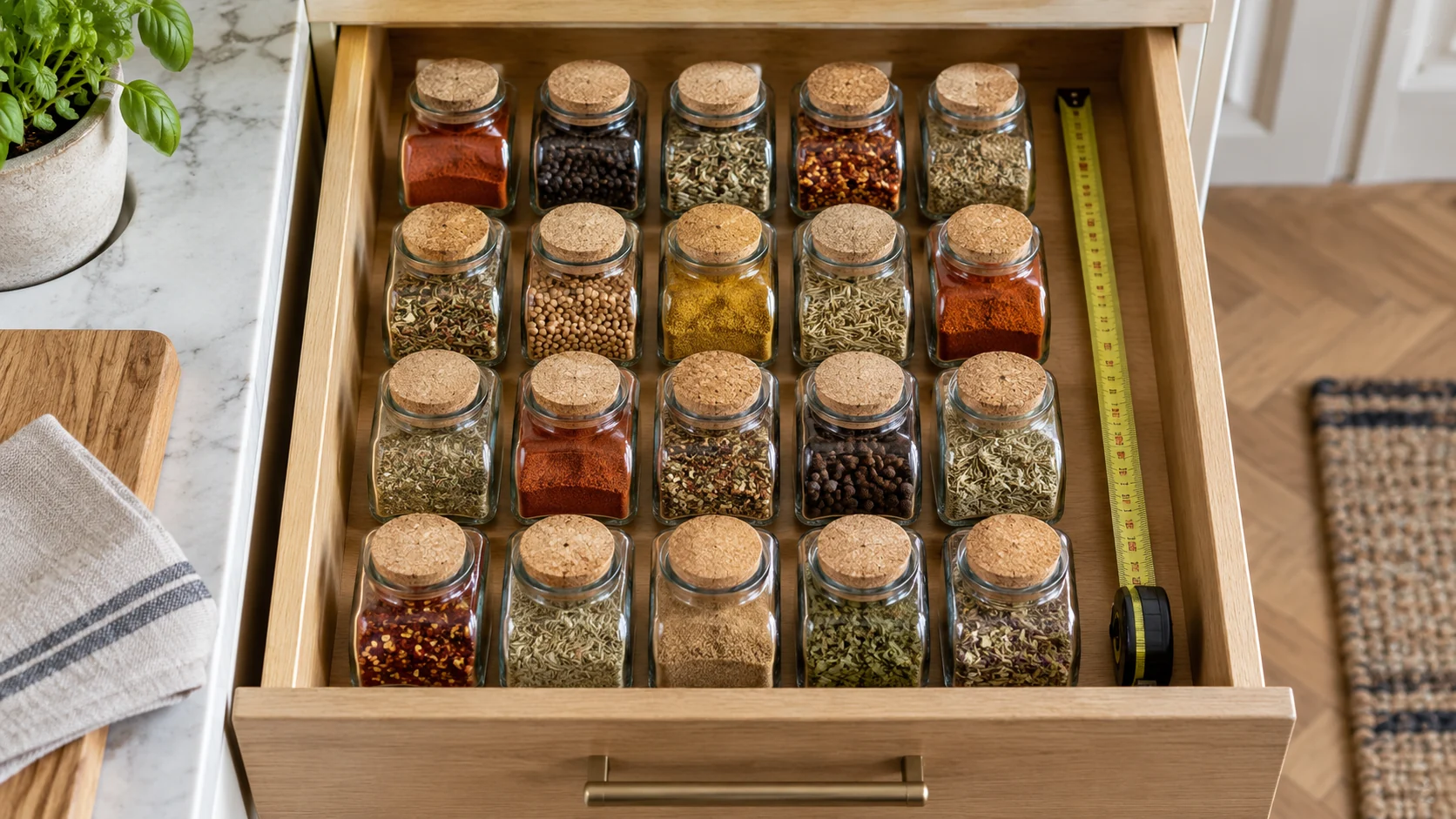
| Relaxdays 10047464 | 20 jars; each H 7 × W 5 × D 5 cm, about 100 ml; labels, funnel and pen | Glass jars with cork lids for an organised drawer or shelf | Drawer height, lid fit and space to lift each jar |
| Relaxdays 10043746 | Rack H 27.5 × W 20 × D 20 cm; 16 jars, about 100 ml each | 360° rotating holder with glass jars and shaker inserts | Clearance to rotate the rack and remove jars, including below cupboards |
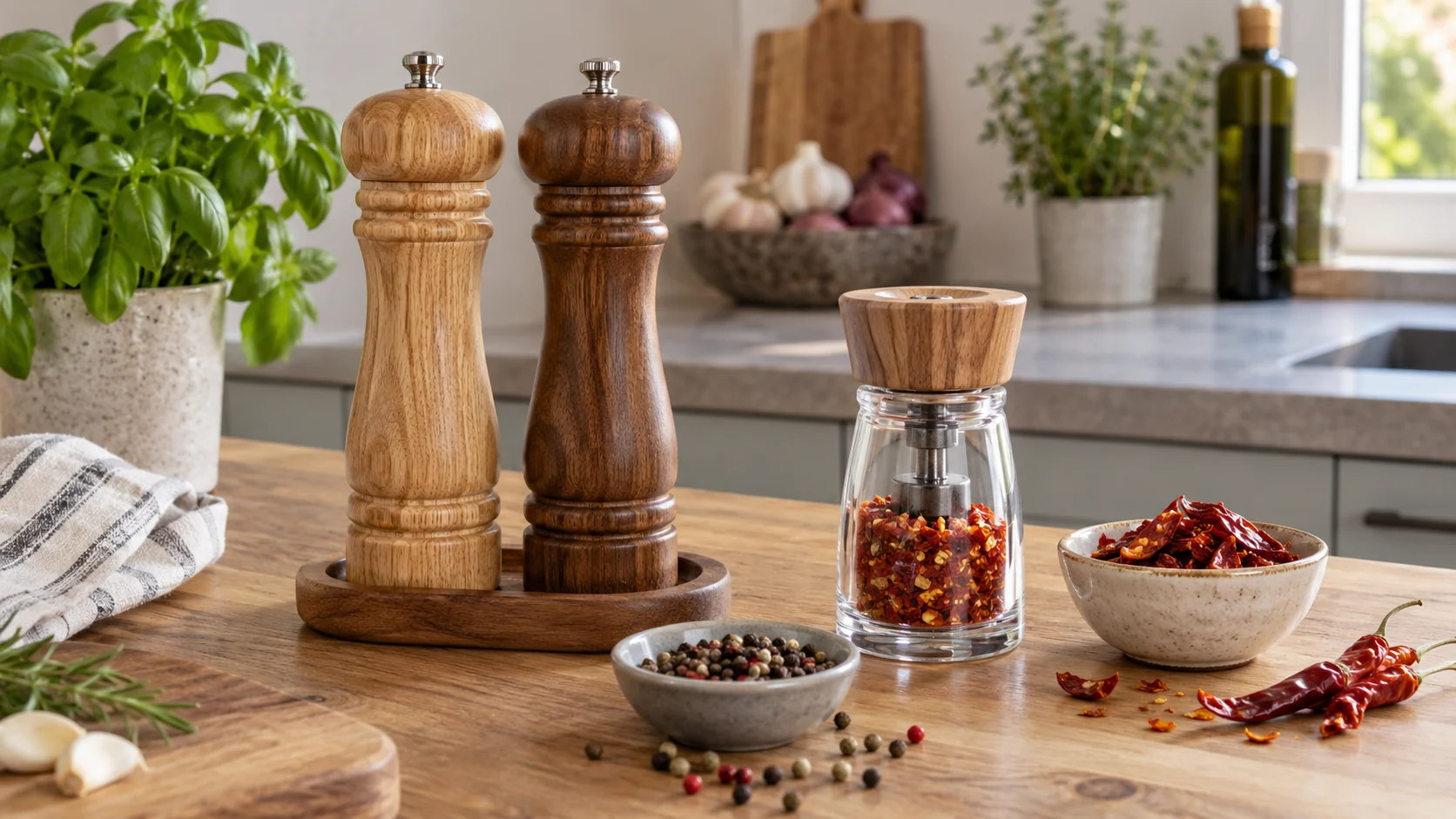
| Relaxdays 10045183 | Two manual mills; each H 21 cm, Ø 5.5 cm; tray and cleaning brush | Salt and pepper; wooden body and adjustable ceramic mechanism | Approved ingredients and comfortable operation |
| Relaxdays 10023280 | One manual chilli mill; H 16 cm, Ø 6.5 cm; glass and stainless steel | Cutting dried chilli into flakes with a dedicated mechanism | Whether you want flakes; this is not a universal pepper mill |
The dimensions in the 10045183 product name should not be read as the dimensions of a single mill: the manufacturer gives approximately 21 cm height and 5.5 cm diameter per mill. Allow space for the tray as well. Jars and mills are not a supplied spice assortment; ingredients shown in photographs should not be assumed to be included.
How should you choose spice jars and their storage position?
Match capacity to what you use
List your regular spices, separate everyday ingredients from occasional ones, and check the sizes of packets you normally buy. A roughly 100 ml jar can suit a small supply, but millilitres do not tell you how many grams will fit. Peppercorns, ground paprika and dried leaves have different densities. Do not convert packet weight into jar volume on a one-to-one basis.
A 20-piece set makes sense if you use that many varieties and have room for them. Otherwise, keep spare jars empty until needed. Avoid buying and decanting extra spices simply to fill a display: smaller quantities that you regularly use are easier to track.
Glass, lids and dispensing openings do different jobs
Glass spice jars make contents and fill level visible, but clear glass does not shield spices from light. Store them in a cupboard or away from direct sunlight. Cork lids offer quick opening; assess how well the lid fits rather than assuming all cork-lidded jars seal equally well. Appearance and closure performance are separate considerations.
Shaker inserts suit small free-flowing particles, while larger herb leaves may not pass through small holes. If you often measure with a teaspoon, check the opening width and whether the insert can be removed. A jar stores, a shaker dispenses and a mill changes particle size; one does not automatically replace the others.
Use clear labels and keep spices dry
Spice jars with labels reduce confusion between similarly coloured ingredients. Mark the name and add the filling or opening date separately. Keep the original packet's best-before date, ingredient list and allergen information. Top-facing labels work well in a drawer; front-facing labels are easier to read on a shelf.
Choose a dry location protected from heat and direct light. Avoid the area above the hob and places exposed to steam. Dispense into a dry spoon or small bowl before adding to the pan, so the open jar is not held above rising steam. Never dip a wet spoon into dry spices.
Will the jars or rotating spice rack fit your kitchen?
Measure the usable drawer interior
Measure internal width, depth and closing height at the tightest point. Cabinet dimensions are not drawer dimensions. Include rails, any crosspiece and the thickness of an organiser. Measure jars with their lids fitted and leave enough room to grip them.
Twenty jars with 5 × 5 cm bases, arranged in five rows of four, theoretically cover 25 × 20 cm. This is only the sum of their footprints: add gaps, the organiser, sloping walls and room to lift them. Paper squares measuring 5 × 5 cm offer a simple pre-purchase layout check. Your final arrangement may differ.
A rotating rack needs operating space
The 10043746 rack needs more than a free 20 × 20 cm patch. Near a wall or other objects, make sure it can rotate and that jars can be pulled out. Its 27.5 cm height also needs to fit below wall cupboards. Keep its top free of items that obstruct access.
Spice jars with a stand suit a collection that you want together and easy to move to the table. The rack does not improve storage conditions by itself: a sunny counter or a position next to the hob may make a drawer or cupboard more suitable.
Plan refilling and cleaning
Check the neck shape as well as capacity. A funnel helps with fine ingredients, but larger leaves may bridge across it. Removable inserts and accessible jar bottoms are useful when changing contents. Confirm which parts can be washed separately and how the lid should be cared for.
Do not assume a complete set is dishwasher safe because the jars contain glass. Follow the product instructions for cork, wood, labels and grinding mechanisms. Refill only when the jar is completely dry, and avoid continually topping up old residues with a new batch.
Salt, pepper and chilli mills: what is the difference?
Manual mills for everyday table use
The 10045183 set contains two manual mills, a tray and a brush. Its adjustable ceramic mechanism lets you change coarseness; begin with a small amount and adjust gradually. The tray collects residual particles, but still needs regular cleaning.
Check approved ingredients, grain size, filling access and how comfortable the mill is to turn. A ceramic mechanism does not mean that any seed, damp salt or oily mixture can be used. Do not force a jammed mill; check its contents and instructions first.
A chilli cutter uses a different mechanism
The 10023280 is designed to cut dried chilli into flakes. Its dedicated cutting mechanism differs from a ceramic salt and pepper grinder. It can be useful for adding flakes to pizza and other dishes, but should not be chosen as a universal replacement for all spice mills.
Check permitted ingredients, filling access and disassembly instructions. Dry washable parts completely before reassembly. Dedicating this mill to chilli and labelling it clearly helps prevent hot residues from transferring to another ingredient.
When is an electric spice grinder worth considering?
An electric mill may be convenient for one-handed use with less twisting. Check its power source, button position, weight, coarseness adjustment and approved ingredients. Batteries or a charging cable are not necessarily included.
A manual model needs no power but requires turning or pressing. An electric model needs battery or charging maintenance, and its motor section must be protected from water. A light helps you see where seasoning falls; it does not guarantee uniform grinding or a precise dose. Choose around actual operation rather than the longest feature list.
10 checks before buying spice jars or mills
- Count regularly used spices. Match the set size to actual need.
- Separate storage and processing. Jars, shakers and mills have different purposes.
- Check volume. Do not convert millilitres to grams without knowing the ingredient's density.
- Measure the space. Include the drawer interior, fitted lids and cupboard above.
- Leave access. Jars must lift out and rotating racks must turn.
- Inspect the closure. Lid fit matters more than the material name alone.
- Plan labelling. Keep names and dates visible.
- Choose a dry position. Avoid sunlight, hob heat and steam.
- Check mechanism compatibility. A chilli cutter is different from a pepper mill.
- Read care and delivery contents. Check lids, inserts, batteries and accessories separately.
Then compare all Bonideco spice jars, racks and mills. Select size and purpose first, then choose materials and colours that suit the kitchen.
Frequently asked questions about spice jars and grinders
What size spice jars should I choose?
Match the jars to your usual packet sizes and consumption. Around 100 ml can suit a small supply, but the number of grams depends on the ingredient. Occasional spices may not need large jars.
Are glass spice jars better?
Glass makes contents visible, but admits light and can break. Assess the lid, storage position and care requirements together; glass alone does not establish an airtight seal.
Should I use a spice rack or drawer?
A rack keeps frequent ingredients accessible. A drawer protects from direct light and clears the counter if the jars fit and their names can be read from above.
Can every grinder handle both salt and pepper?
No. Suitability depends on the mechanism and the manufacturer's approved ingredients. A dedicated chilli cutter should not be treated as a salt and pepper mill.
Can a spice grinder go in the dishwasher?
Only when the instructions explicitly allow it. Do not automatically immerse motors, wooden parts or grinding mechanisms. Dry washable components fully before assembling them.
Are spices included in the sets?
Check the stated delivery contents. This comparison covers jars, a rack and mills; spices pictured in product photographs do not establish that ingredients are supplied.