


How to choose a dog crate: size, travel and 4 models
A practical guide to measuring your dog and space, choosing a crate for home or car use, and comparing four different designs.
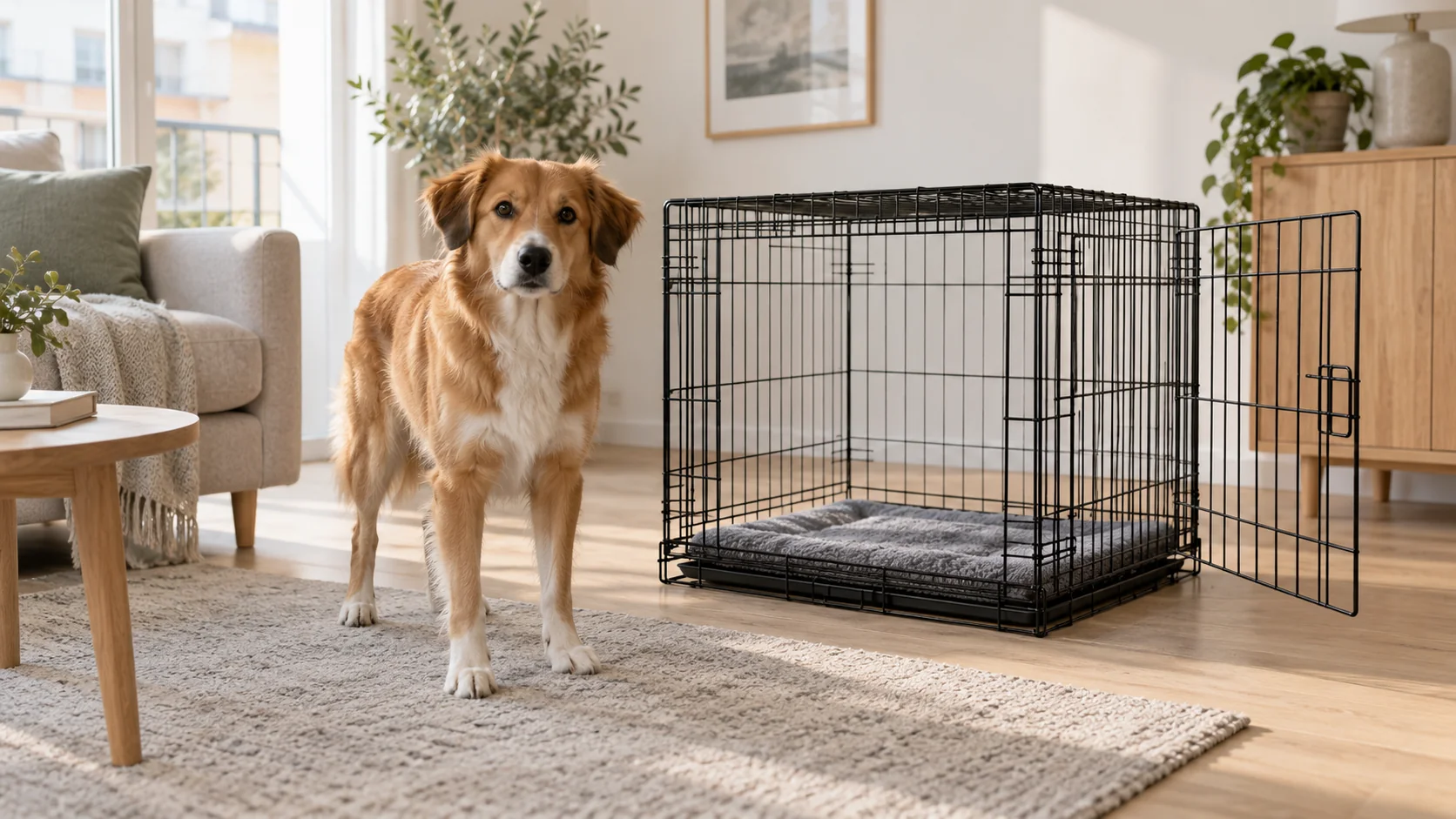
A suitable dog crate cannot be chosen by weight alone. Your dog must be able to stand naturally, turn around, lie down and stretch, while the crate itself must suit its intended setting: the home, short trips or a car boot. This guide explains how to measure your dog and the available space, how soft, wire and vehicle crates differ, and compares four current products from the Bonideco dog carriers and crates range.
Quick choice: the 50 × 35 × 35 cm soft carrier is intended for a small pet up to 7 kg; the larger fabric crate is useful when ventilation and compact folded storage matter; the wire crate is a roomy home option for a large dog when its dimensions match the animal; an aluminium vehicle crate should only be selected after measuring the boot floor, opening and closed tailgate angle.
Dog crates and carriers: comparison of four models
The four products represent clearly different uses: a compact soft carrier, a larger folding fabric crate, a wire crate for a large dog and an aluminium box for a car boot. Dimensions, weights and equipment were checked against the Bonideco catalogue on 2 October 2026. This is a comparison of declared specifications rather than a physical safety test. Current price, availability and delivery information appears in the product cards.
| Model | Dimensions and weight | Construction | When to consider it |
|---|---|---|---|
| PDC50G01 | 50 × 35 × 35 cm; 2.2 kg | Metal frame, 600D Oxford fabric and soft lining; folds to 8 cm high | For a small dog or cat up to 7 kg when light carrying and compact storage matter |
| Feandrea PDC017B01 | 76.2 × 53.4 × 53.4 cm; 3.4 kg | Steel frame, 600D Oxford fabric, four mesh doors, handles and pockets | For a small dog at home or while travelling when ventilation and folding storage are priorities |
| Feandrea PPD015B01 | 120 × 72.5 × 109 cm; 16 kg | Folding wire crate with two doors; 10 cm high when folded | For a large dog when a roomy wire crate and access from two sides are needed |
| PW10154 | 89 × 69 × 50.5 cm; 11.5 kg | Aluminium frame, mesh panels, double-locking doors and removable divider | For a car boot only when the shape and every external dimension fit the vehicle |
Remember: external dimensions are not the usable internal space. Fabric, frames, doors and dividers reduce it. A stated weight or size limit is a useful filter, but the dog’s actual length, standing height, width and ability to change position determine the final fit.
How should you measure a dog and the crate location?
Measure the dog in a natural position
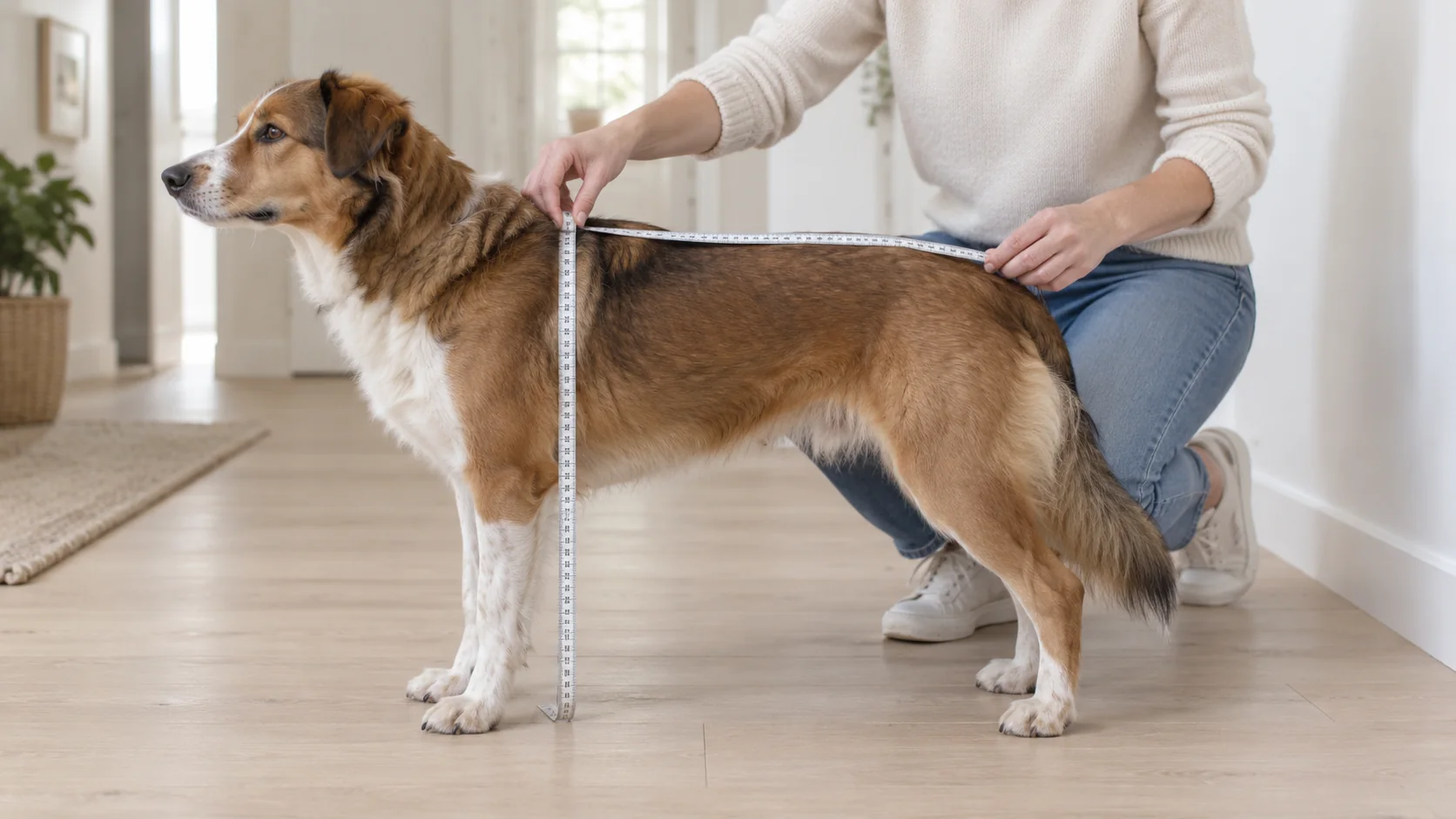
Measure while your dog stands calmly on a level surface. Record body length from the nose to the base of the tail, height from the floor to the highest point of the head or ears, and the widest part of the body. Upright ears, a high head carriage and a thick coat all require room. Do not round down or rely only on a breed label, because dogs of the same breed can have different proportions.
Inside the crate, the dog must be able to stand without crouching, turn easily, lie in a natural position and stretch. When only external measurements are available, request the internal measurements or allow for the frame and wall thickness. A puppy’s future adult size does not automatically make an oversized travel box suitable now; a home crate for growth and a correctly fitted travel crate may be different purchases.
Measure the full operating area
At home, mark the full length and width on the floor. Check that the chosen door opens completely and leave enough room to kneel, remove bedding and clean the corners. The crate should not block a doorway, radiator, ventilation opening, escape route or everyday passage. Choose a quiet position away from strong direct sunlight and draughts.
Plan where a folding model will be stored. PDC50G01 and PDC017B01 fold to roughly 8 cm high, while PPD015B01 folds to 10 cm, but their length and width remain substantial. Confirm that you can carry the folded unit through doors and store it without bending the frame.
Match the door position to the room
Two or four doors provide layout flexibility only when the selected opening can swing fully. A door against the wall becomes unusable. Check the latch position, threshold and whether an open panel obstructs a walkway. Close soft-crate zips fully as directed; a dog that chews fabric or forces the mesh may require a different construction.
Soft or wire dog crate: which design should you choose?
Soft carrier for a small pet
PDC50G01 measures 50 × 35 × 35 cm and is listed for pets up to 7 kg. Its 2.2 kg weight, handles and folding frame make it easier to carry and store. The weight limit alone does not establish fit: compare the pet’s body length and standing height. Inspect the base support, zips, handle seams and mesh before every journey.
A soft carrier is unsuitable for a dog that persistently chews fabric, claws the mesh or panics while enclosed. Address stress and crate familiarisation first, then choose a structure that reflects the dog’s real behaviour. For air travel, a product name or general description is never enough; each airline applies its own external-size, construction and documentation rules.
Larger folding fabric crate
Feandrea PDC017B01 has a steel frame, four mesh doors and external dimensions of 76.2 × 53.4 × 53.4 cm. Mesh provides visibility and airflow, while multiple openings help in different room layouts. A weight of 3.4 kg and folded height of 8 cm are useful if the crate is moved frequently.
Fabric and mesh resist pressure and chewing less effectively than wire. This format is best for a dog already comfortable in an enclosed resting space. Regularly inspect the seams, zips and frame joints. Do not make repairs that leave sharp ends or loops inside.
Wire crate for the home
Feandrea PPD015B01 is a large folding metal model with two doors. It measures 120 × 72.5 × 109 cm and weighs 16 kg. The wire sides provide visibility and ventilation, and the two-door layout offers more placement options. Before ordering, make sure the 109 cm height is actually appropriate and that the unit will pass through the doorways leading to its intended location.
At home, the crate should become a safe resting place rather than a punishment. Begin with the door secured open so it cannot swing, allow the dog to investigate at its own pace and build positive associations in short steps. If the dog shows severe distress, excessive salivation, tries to break out or injures itself, stop closing the crate and seek advice from a veterinarian or suitably qualified behaviour professional.
How do you choose a dog crate for a car?
Measure the boot opening, floor and tailgate angle
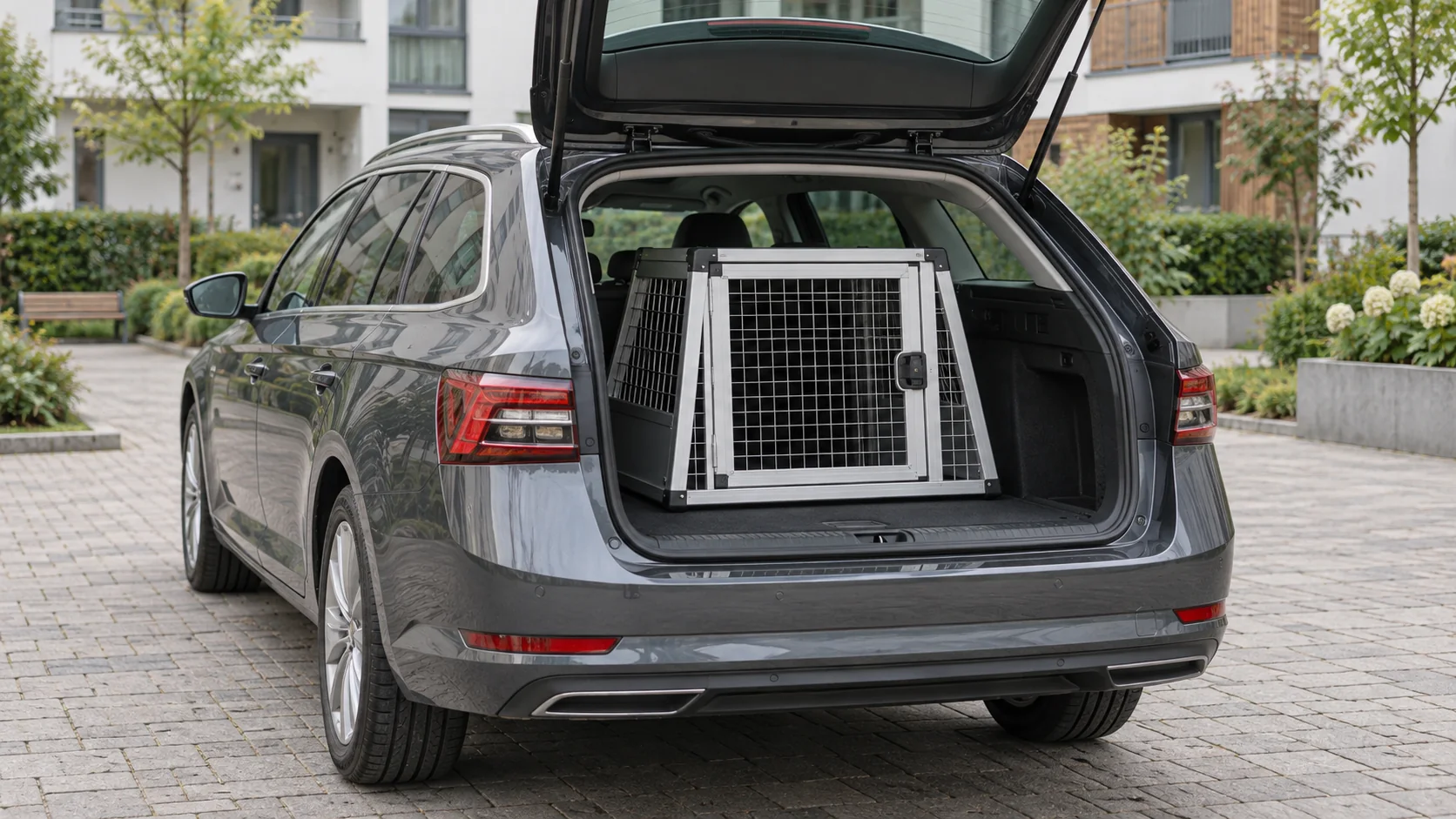
Boot capacity in litres is insufficient. Measure the opening at its narrowest width and height, the usable floor depth, the space between wheel arches and the slope of the closed tailgate. A rigid crate may fit the floor yet touch the rear window when the hatch closes. A simple cardboard mock-up can reveal these conflicts before purchase.
Check restraint and access
The crate must stand securely and be restrained according to both the crate and vehicle manufacturer’s instructions, using suitable anchor points. Do not block ventilation, emergency equipment or the crate door. Confirm that you can load the dog away from moving traffic and that the latch does not strike the boot trim.
PW10154 measures 89 × 69 × 50.5 cm and includes mesh panels, double-locking doors and a removable divider. Use the divider only when each resulting compartment is large enough for the individual animal. Two dogs also need to be compatible; one divided box does not itself guarantee a safe journey.
Monitor temperature and welfare
Before a longer trip, introduce both crate and car in short calm stages. During travel, monitor temperature, airflow and the dog’s condition, and plan breaks around its needs. Never leave a dog alone in a parked vehicle: the passenger and cargo areas can heat rapidly even when the outdoor temperature seems mild.
For international travel, check current identification, vaccination, document and operator requirements in advance. Airlines, ferries and trains may impose different crate dimensions and construction rules from travel in a private car.
10 checks before buying a dog crate
- Measure the dog. Record natural body length, standing height and widest point.
- Check internal space. The dog must be able to stand, turn, lie down and stretch.
- Define the use. A home resting crate, hand-carried bag and vehicle box solve different needs.
- Mark external dimensions. Check floors, doors, walkways and cleaning access.
- Assess construction. Fabric suits a calm dog; persistent chewing or escape behaviour calls for another solution.
- Keep ventilation clear. Mesh must not be obstructed by walls, luggage or vehicle trim.
- Test access. Doors should open fully and latches remain easy for a person to reach.
- Measure the car opening. Include wheel arches, rear glass, tailgate slope and anchor points.
- Plan familiarisation. Introduce the crate gradually and positively; never use it as punishment.
- Read the exact product page. Variant SKUs, dimensions, equipment and limitations can differ.
After these checks, browse all Bonideco dog crates and carriers. Filter by your dog and intended location first, then compare colour, pockets and accessory compartments among the designs that genuinely fit.
Frequently asked questions about dog crates
What size crate does a dog need?
Choose enough internal room for the dog to stand naturally, turn easily, lie down and stretch. Compare body length, height and width with internal dimensions. Weight and breed name alone are insufficient.
Can a dog crate be too large?
Extra space in a stable home resting crate is often manageable if the dog feels secure. During transport, a disproportionately large box may permit excessive movement under sudden braking, so match its size to the dog and transport method.
Is a soft or wire crate better?
A soft crate is lighter and stores compactly, but it does not suit every dog that chews or becomes anxious. A wire crate is heavier, well ventilated and generally more resistant. Behaviour, location and purpose should decide.
Can any dog crate be used in a car?
Only when it fits without blocking doors or ventilation, can be restrained properly, and its manufacturer permits that use. A catalogue statement cannot replace checks of the vehicle opening, anchor points and the individual dog.
How do you introduce a dog to a crate?
Begin with the door secured open and let the dog enter voluntarily. Use short positive sessions, a calm approach and suitable rewards. Increase time only while the dog remains relaxed, and never use the crate as punishment.
Can a dog stay in a crate for a full working day?
A crate is not an all-day living space and cannot replace exercise, social contact, water and regular toilet breaks. Appropriate duration varies with age, health, training and individual needs. Ask a veterinarian about routines for puppies, senior dogs or animals with medical conditions.